Crown Reductionin Watford & Hertfordshire— done without ruining the tree.
Bring an oversized, unsafe or light-blocking tree back under control while keeping its natural shape and long-term health. Fixed price, no day rate, TPO paperwork handled for you.
9.94/10 across 502 Checkatrade reviews · Free site visit · Fixed-price quote within 24 hours
Watford · Bushey · Radlett · Harrow · St Albans
What crown reduction actually involves
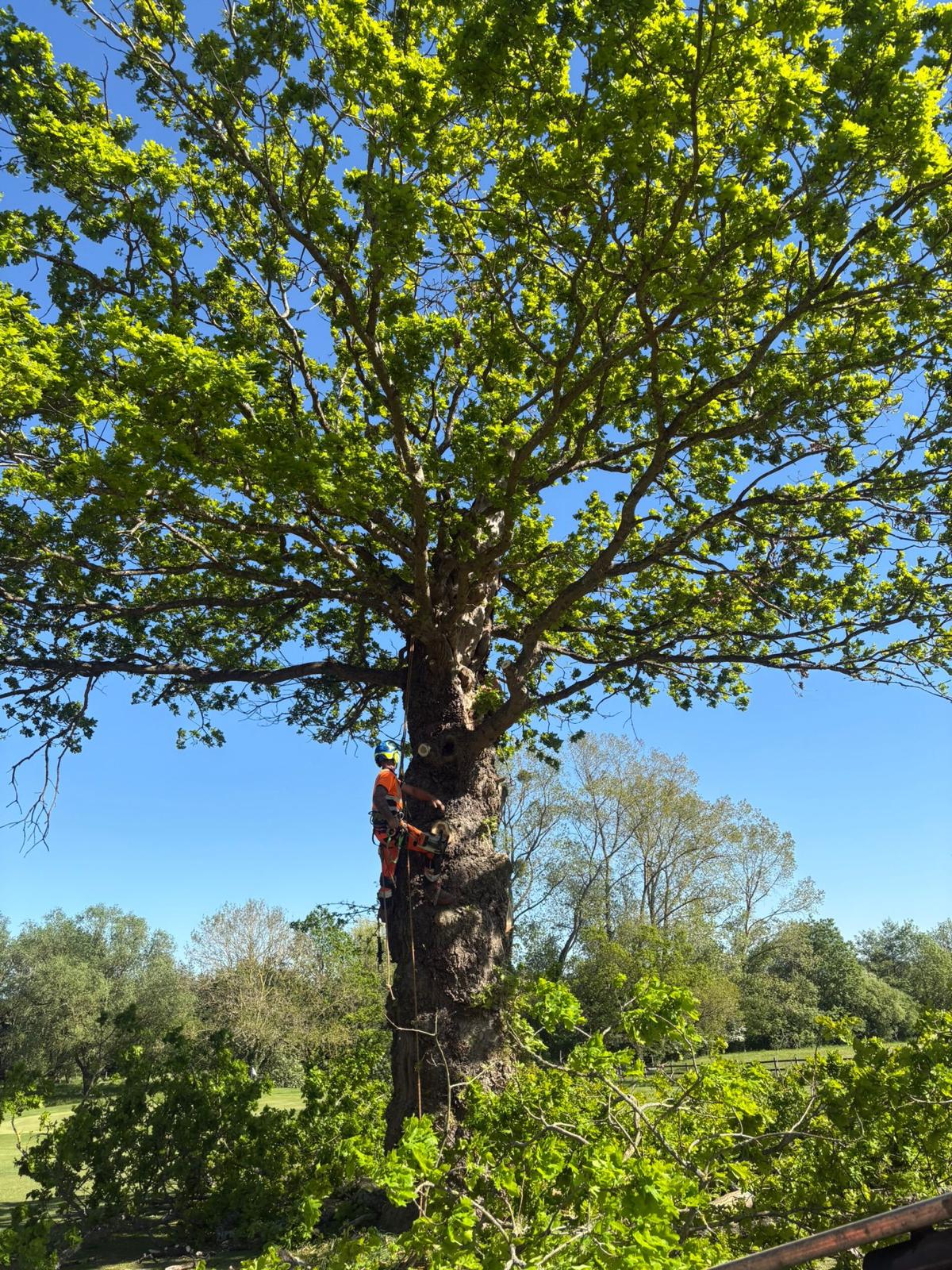
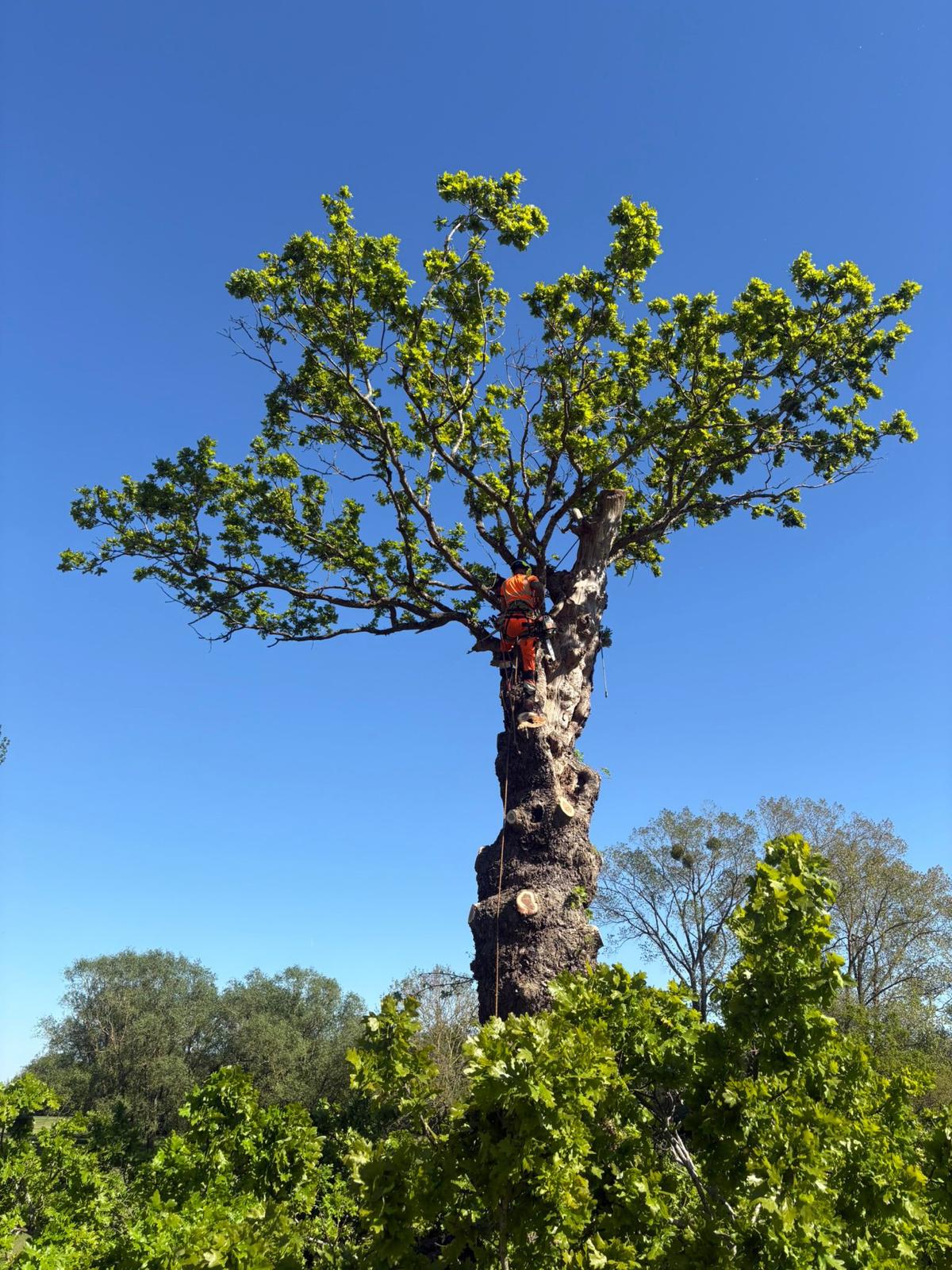
Crown reduction shortens the height and/or spread of a tree by selectively cutting back to smaller side branches evenly across the whole canopy — not lopping the top off. Done properly, the tree keeps its natural shape and continues to grow healthily; done badly, you get a topped, weakened tree that throws out weak regrowth.
Homeowners with mature trees that have outgrown a garden, landlords and property managers reducing storm risk over cars, roofs and pavements, and estate owners managing veteran trees. If a tree feels 'too big for the space' but you don't want it gone, this is usually the answer.
When branches are close to a roof, gutters, windows, wires or a boundary; when the tree is blocking significant light to a garden or property; when previous work has left an unbalanced or top-heavy crown; or after storm damage has left one side heavier than the other.
The wrong cut in the wrong place kills mature trees slowly. A qualified arborist reads branch collars, structural unions, wound response and species tolerance before making a single cut — an untrained hand with a chainsaw doesn't, and the tree pays for it two or three seasons later.
What happens if you put it off
An oversized crown doesn't just look untidy. It shades out gardens, loads walls and fences, catches wind like a sail in storms, and drops limbs on cars, sheds and conservatories. Every winter you leave it, you're rolling the dice.
Storm-drop damage
A top-heavy crown catches wind loads it wasn't grown to carry. One December gale is enough to take a limb through a conservatory roof or a parked car.
Structural decline
Included bark unions and long lever arms crack under their own weight. Once a major limb fails, the wound rarely closes cleanly.
Neighbour disputes & insurance
Overhanging branches, blocked light and boundary damage turn into solicitor letters. Insurers can refuse claims where a tree was 'obviously' neglected.
Common mistakes we're called in to fix
- Topping the tree with straight horizontal cuts — this triggers dense, weakly-attached regrowth that fails within a few years.
- Reducing by more than 30% in one visit — the tree can't photosynthesise enough to recover.
- Cutting between nodes rather than back to a suitable growth point, leaving stubs that rot back into the main stem.
- Doing the work without checking for a TPO or conservation area — that's a £2,500 fine per tree with prosecution on top.
A clear, quoted, tidy job — every time
No day rates. No guesswork on the day. You know what we're doing, when, and what it costs before a single cut is made.
- 1
Free site visit
We meet you, look at every tree properly from ground and canopy, and understand what you're trying to achieve.
- 2
Written fixed-price quote
You get one price for the whole job — climb, cuts, chipping and clear-up — within 24 hours.
- 3
TPO & neighbour notice
If the tree is protected or overhangs a boundary, we handle the council 6-week notice and any neighbour communication.
- 4
Reduction to spec
Climbing team reduces the crown to the agreed percentage, cutting back to appropriate growth points across the whole canopy.
- 5
Clear, chip & sign-off
All arisings chipped or removed under our Environment Agency waste carrier licence. We walk the job with you before we leave.
What you actually get when we do the job
Keeps the tree's natural shape
Selective cuts back to lateral growth — the tree still looks like a tree, not a coat rack.
Cuts storm risk
Less sail area and shorter lever arms mean the crown handles gales the way nature intended.
Restores light to the garden
Most clients see dramatically brighter lawns and beds within a week.
Protects the tree long-term
Correct pruning wounds seal cleanly. Bad cuts invite decay for the rest of the tree's life.
One fixed price
No day rate. No 'while we're here' extras. Written quote, honoured.
TPO paperwork handled
We deal with the council so you don't have to — and so you don't get fined.
Crown Reduction — the full picture
How much can safely be removed
For a healthy, mature broadleaf, the industry accepted maximum is roughly 30% of the live crown in a single visit — and often much less on older or stressed trees. We measure and mark, we don't guess. On veteran oaks and beeches we frequently reduce more conservatively (10–20%) and re-visit on a 3–5 year cycle rather than shocking the tree.
Species-specific considerations
Oaks respond well to reduction if worked outside the beetle vector season (roughly April–July). Silver birch and cherry are prone to bleeding and best pruned in mid-summer once sap flow has slowed. Beech has thin bark and takes badly to heavy reduction — light, regular work is far kinder. Conifers (except yew) generally do not regenerate from bare wood and are handled very differently.
Residential vs commercial reductions
On residential jobs we typically climb on ropes and lower sections by hand into a rear garden, using ground protection to avoid lawn damage. On commercial and highway sites we work to a written RAMS document, coordinate with traffic management, and can schedule out-of-hours or weekend work to minimise disruption to staff, pupils or the travelling public.
TPOs, conservation areas and the paperwork
Watford, Three Rivers, Hertsmere, Dacorum and St Albans all actively enforce Tree Preservation Orders. Working on a TPO tree without consent is a criminal offence carrying fines up to £20,000 in magistrates' court. We check the local authority tree register on your behalf, submit the 6-week Section 211 notice (conservation area) or full TPO application, and only start work once written consent is in place.
Crown Reduction: your questions, answered straight
How much does crown reduction cost in Watford & Hertfordshire?
Prices are set per job after a free site visit — never a day rate. Cost varies with tree size, species, access and how the arisings need to be removed. You get one written fixed price within 24 hours; that's the price you pay.
How long does a typical reduction take?
A single mature garden tree is usually a half-day to full-day job for a two- or three-person team. Larger trees or awkward-access sites can run 1–2 days. We confirm the day and duration in your quote.
Will it kill the tree?
Not when it's done correctly. We work within accepted industry limits (typically up to ~30% of live crown for a healthy broadleaf) and cut back to appropriate growth points so the wounds seal properly. Overzealous reduction — 'topping' — will damage a tree; we don't do it.
How often will it need doing again?
For most garden trees, every 3–5 years is typical, depending on species and growth rate. Fast growers like willow and poplar can need attention every 2–3 years; slower species like oak might go 5–10.
Do you handle the council TPO application?
Yes — included as standard when your tree is protected or in a conservation area. We prepare and submit the paperwork on your behalf and only book the work in once written consent is received.
Are you insured?
Fully. £10 million public liability and £5 million employers' liability. Certificates available on request before the job starts.
What happens to the wood and brash?
It's chipped on site or taken away — your choice. We're registered with the Environment Agency as a waste carrier so it's all disposed of legally.
Do you cover emergencies?
Yes — 24/7. If a limb has come down or a tree is leaning, call us on 07960 863854 and we'll respond straight away.
Ready to sort your crown reduction? Get a fixed price in 24 hours.
Free site visit. Written quote — not a day rate. Council TPO paperwork handled on your behalf. Full clean-up and all waste chipped or taken away under our Environment Agency waste carrier licence.
- Owner-led team — Sam or the team quote every job in person
- £10m public liability + £5m employers' liability
- NPTC CS39 climbers, City & Guilds qualified
- 24/7 phone answered for emergencies
Request your free quote
Tell us what you need — we'll come and take a proper look.