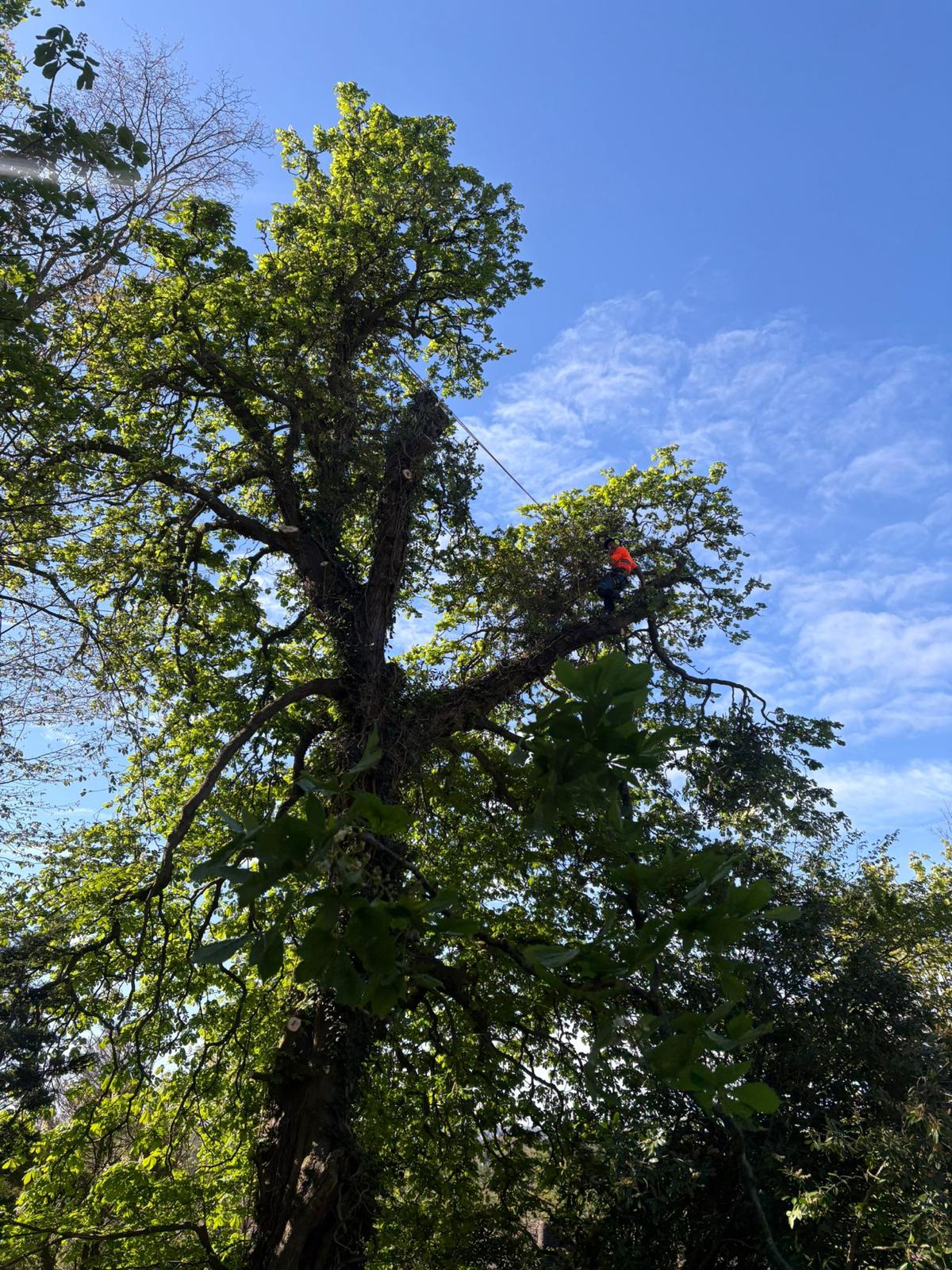
Tree Pruningin Watford, Bushey & across Herts— cuts that heal, not scar.
Formative pruning for young trees, health pruning for mature ones, and dead-wood removal — carried out by NPTC-qualified arborists to British Standard 3998. Fixed-price quotes, TPO paperwork included.
9.94/10 across 502 Checkatrade reviews · Free site visit · Fixed-price quote within 24 hours
Watford · Bushey · Radlett · Harrow · St Albans
What tree pruning actually involves
Pruning is the removal of specific branches to improve a tree's structure, health, safety or appearance. Done to BS3998, cuts are made just outside the branch collar so the tree can seal the wound naturally.
Anyone with young trees that need training into good structure, mature trees needing dead-wood removal or lift over paths, and fruit or ornamental trees whose performance depends on annual work.
For most deciduous species, during dormancy (late autumn to early spring). Bleeders (birch, cherry, walnut, maple) in mid-summer. Formative work on young trees in the first few years after planting.
'Just tidy it up' is what kills mature trees. Cuts inside the branch collar can't seal. Cuts to internodes leave rotting stubs. Removing more than 20% in a year exhausts the tree. A qualified arborist knows exactly where to make the cut — and, more importantly, where not to.
What happens if you put it off
A tree carries every bad cut for the rest of its life. The rot doesn't go away — it spreads into the main stem, weakens major unions and eventually costs you the tree.
Permanent internal decay
A single flush cut inside the branch collar opens the tree to fungal decay that spreads down the trunk over 10–20 years.
Weak, dangerous regrowth
Bad pruning triggers epicormic 'water shoots' that grow fast, attach weakly and drop in storms.
Fruit and flower failure
Wrong-season pruning removes next year's flower buds. One season of unqualified 'tidying' can cost a fruit tree two years of crop.
Common mistakes we're called in to fix
- Flush cuts hard against the trunk — impossible for the tree to seal.
- Painting cut wounds — traps moisture, promotes decay. Not recommended in modern practice.
- Removing more than 20% of live wood in a single year.
- Pruning cherry, birch, walnut or maple in winter — heavy sap bleed and disease risk.
A clear, quoted, tidy job — every time
No day rates. No guesswork on the day. You know what we're doing, when, and what it costs before a single cut is made.
- 1
Free assessment
We identify species, age, condition and objectives.
- 2
Written fixed price
One quote for the whole job — within 24 hours.
- 3
Consents if needed
TPO or conservation area applications handled.
- 4
Pruning to BS3998
Each cut placed correctly at the branch collar, distributed across the crown.
- 5
Clear-up & sign-off
All arisings chipped or removed. Walk the job with you.
What you actually get when we do the job
Wounds that seal cleanly
Correct cut placement means the tree closes over the wound within a couple of seasons.
Stronger long-term structure
Formative pruning on young trees prevents the co-dominant stems that fail decades later.
Better fruit & flowering
Right pruning at the right time transforms yield and display.
Safer canopies over paths & drives
Crown lifting removes low branches that snag delivery vehicles and pedestrians.
Fixed price
No day rate, no on-the-day surprises.
Fully insured NPTC team
£10m PL, CS39 climbers, BS3998 practice.
Tree Pruning — the full picture
Formative pruning for young trees
The best money you'll ever spend on a tree. In the first 5–10 years after planting we shape the structure — one clear central leader, well-spaced main scaffold branches, no included bark unions. Trees pruned properly when young almost never need major structural work in maturity.
Maintenance & health pruning for mature trees
Dead-wood removal (see our dead-wooding page), crown cleaning (removal of crossing, rubbing, weakly-attached branches), and selective thinning to improve air and light movement. Typically light, on a 3–5 year cycle.
Crown lifting for clearance
Removing lower branches to give agreed vertical clearance over paths, driveways, roads or lawns. UK standard is 2.4m over pedestrian areas and 5.2m over highways — we work to whichever spec is appropriate.
Fruit tree pruning
Apples and pears (pip fruit) in winter; plums, cherries and other stone fruit in mid-summer to avoid silver leaf infection. We prune for structure, air flow and cropping — not just size.
Tree Pruning: your questions, answered straight
When is the best time of year to prune?
Depends entirely on species. Most deciduous broadleaves — dormant season (Nov–Feb). Bleeders (birch, cherry, walnut, maple) — mid to late summer. Oaks — outside beetle vector season (avoid April–July). Evergreens — late spring.
How much pruning is safe in one year?
Industry guidance is up to about 20% of the live wood in a single year on a healthy tree. Older or stressed trees, considerably less.
Do you paint the cuts?
No — modern arboricultural practice is not to paint pruning wounds. Sealants trap moisture and slow the tree's own compartmentalisation response.
How much does tree pruning cost?
Fixed price per job after a free site visit — never a day rate. Written quote within 24 hours.
Do you handle TPO applications?
Yes — included as standard when your tree is protected.
How long will the job take?
Most single-tree jobs are half a day to a full day; larger multi-tree work is 1–3 days. Confirmed in your written quote.
Do you clean up afterwards?
Yes — chipped or removed under our Environment Agency waste carrier licence, included.
Are you qualified?
Every climber holds NPTC CS30, CS31, CS38 and CS39 tickets. All work carried out to British Standard 3998.
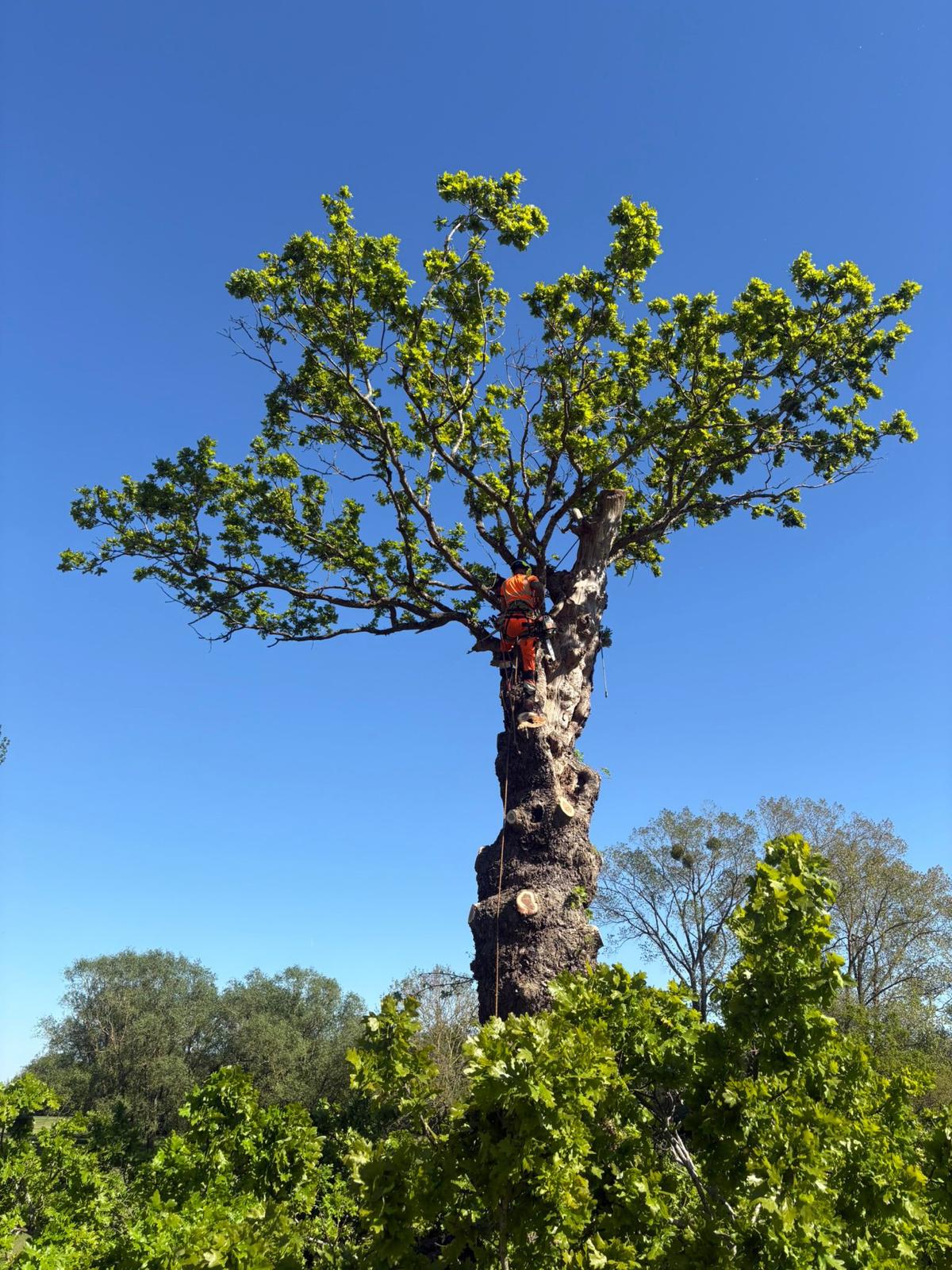
Ready to sort your tree pruning? Get a fixed price in 24 hours.
Free site visit. Written quote — not a day rate. Council TPO paperwork handled on your behalf. Full clean-up and all waste chipped or taken away under our Environment Agency waste carrier licence.
- Owner-led team — Sam or the team quote every job in person
- £10m public liability + £5m employers' liability
- NPTC CS39 climbers, City & Guilds qualified
- 24/7 phone answered for emergencies
Request your free quote
Tell us what you need — we'll come and take a proper look.