Crown Thinningfor lighter, healthier treesacross Watford & Hertfordshire.
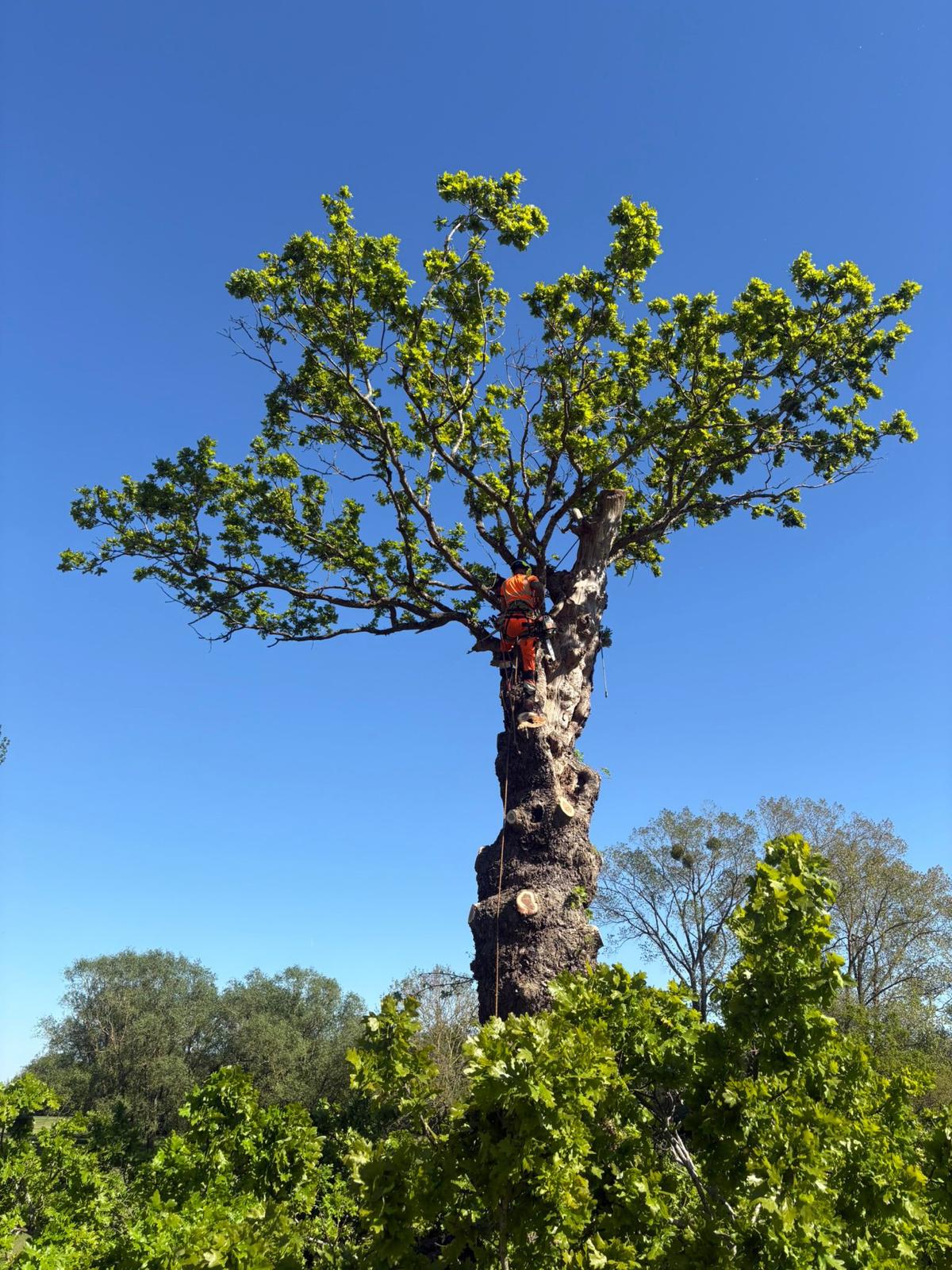
Let light through and reduce wind loading without changing your tree's shape or size. Selective removal of up to 30% of the crown by NPTC-qualified climbers — the tree looks the same, but works better.
9.94/10 across 502 Checkatrade reviews · Free site visit · Fixed-price quote within 24 hours
Watford · Bushey · Radlett · Harrow · St Albans
What crown thinning actually involves
Crown thinning is the selective removal of live branches — usually up to 30% of the crown — plus dead or congested shoots, without changing the tree's overall size or outline. Wind and light move through the canopy more easily, and the tree's structure is improved for the long term.
Homes with dense canopies blocking garden light; commercial sites where wind resistance is a concern; owners of ornamental or feature trees who want to preserve the exact silhouette while improving performance.
When your garden feels dark under a tree that isn't actually oversized; when a tree is throwing dense shadow across solar panels or a lawn; before storm season on exposed sites; when a tree looks 'chesty' with crossing, rubbing or congested growth.
Thinning done badly leaves 'lion-tailed' branches — all growth stripped from the middle, weight only at the tips — which is more dangerous than not thinning at all. Correct thinning is spread evenly through the crown, working with the natural branch structure.
What happens if you put it off
A dense, congested crown doesn't just steal light. It sails in the wind, harbours pests and disease in stagnant air, and hides the crossing branches that will fail first in a storm.
Wind failure
A solid, un-thinned canopy on an exposed site takes the full force of every gust — and roots or main unions give way before the branches do.
Hidden decay
Dead wood and crossing branches you can't see from the ground are the first things to drop. Regular thinning is when they get spotted.
Pest & disease build-up
Poor air movement inside the crown creates the damp, still micro-climate that fungal disease and aphid populations thrive in.
Common mistakes we're called in to fix
- 'Lion-tailing' — stripping all interior growth so weight sits only at the ends of long lever arms. Far more likely to fail than an untouched crown.
- Removing more than 30% in a single visit, especially on stressed or mature trees.
- Cutting large-diameter live branches instead of many small ones — the tree can't seal big wounds well.
- Thinning at the wrong time of year for the species (bleeders like birch, cherry, walnut, maple).
A clear, quoted, tidy job — every time
No day rates. No guesswork on the day. You know what we're doing, when, and what it costs before a single cut is made.
- 1
Free site visit
We assess density, structure and light objectives from ground and often into the canopy on climbing lines.
- 2
Fixed-price quote
One written price within 24 hours — climb, thin, chip and clear.
- 3
Consents (if needed)
TPO / conservation area notices handled on your behalf.
- 4
Selective thinning
Evenly distributed removal of small live branches, dead wood and crossing growth throughout the crown.
- 5
Clean up & walkaround
All arisings chipped or removed. We walk the finished job with you.
What you actually get when we do the job
More light, same shape
Gardens and rooms brighten immediately — but the tree still looks like the tree you love.
Better storm resilience
Wind passes through the crown instead of pushing against it.
Healthier crown structure
Dead wood and crossing branches removed before they fail.
Improved fruit & flowering
More light and air reaches inner buds, so ornamentals and fruit trees perform noticeably better.
Fixed price, no surprises
Written quote, honoured — no day rate.
Fully insured NPTC team
£10m public liability and CS39-certified climbers on every job.
Crown Thinning — the full picture
The 30% rule and why it matters
Removing more than about a third of a healthy tree's living tissue in one visit forces it to draw down stored energy reserves faster than it can replace them. On mature or stressed trees we work well below that limit — the aim is a healthier tree, not a hollow-looking one.
How we distribute the cuts
Good thinning is even. We work systematically from the outside in and from the top down, removing many small-diameter branches spread across the whole crown rather than fewer larger ones. That keeps the natural taper of every limb — no lion-tails, no bare zones.
Timing by species
Deciduous broadleaves are usually best thinned in late summer or the dormant winter months. Bleeders — birch, cherry, walnut and maples — go in mid to late summer. Oaks are avoided in the beetle vector season. We plan the schedule around the species, not around a diary.
Residential vs commercial
On homes we protect lawns with matting and lower every section by hand. On commercial sites — schools, hospitals, estates — we supply full RAMS, work in defined exclusion zones, and can schedule around opening hours.
Crown Thinning: your questions, answered straight
How is crown thinning different from crown reduction?
Thinning removes small branches throughout the crown to open it up — the tree stays the same size and shape. Reduction actually makes the tree smaller. Many jobs use both.
Will thinning hurt my tree?
No, when done inside industry limits (typically up to 30% of live crown) and to correct growth points. Done wrong — 'lion-tailing' or over-thinning — it's harmful, which is why NPTC-qualified climbers matter.
How long does the effect last?
Most trees need re-thinning every 3–5 years to stay open. Vigorous species like sycamore or lime regrow faster and can benefit from a 2–3 year cycle.
How much does it cost?
Fixed price per job after a free site visit — never a day rate. Written quote within 24 hours.
Do you take the waste away?
Yes — chipped on site or removed entirely under our Environment Agency waste carrier licence, included in the price.
How long will the job take?
A single mature garden tree is typically half a day to a full day. We confirm on the written quote.
Do I need council permission?
Only if the tree is protected by a TPO or in a conservation area. We check for you and handle the paperwork if needed.
Can you thin trees in winter?
Yes — the dormant season is often ideal for deciduous species because the structure is visible and there's no leaf load.
Ready to sort your crown thinning? Get a fixed price in 24 hours.
Free site visit. Written quote — not a day rate. Council TPO paperwork handled on your behalf. Full clean-up and all waste chipped or taken away under our Environment Agency waste carrier licence.
- Owner-led team — Sam or the team quote every job in person
- £10m public liability + £5m employers' liability
- NPTC CS39 climbers, City & Guilds qualified
- 24/7 phone answered for emergencies
Request your free quote
Tell us what you need — we'll come and take a proper look.