
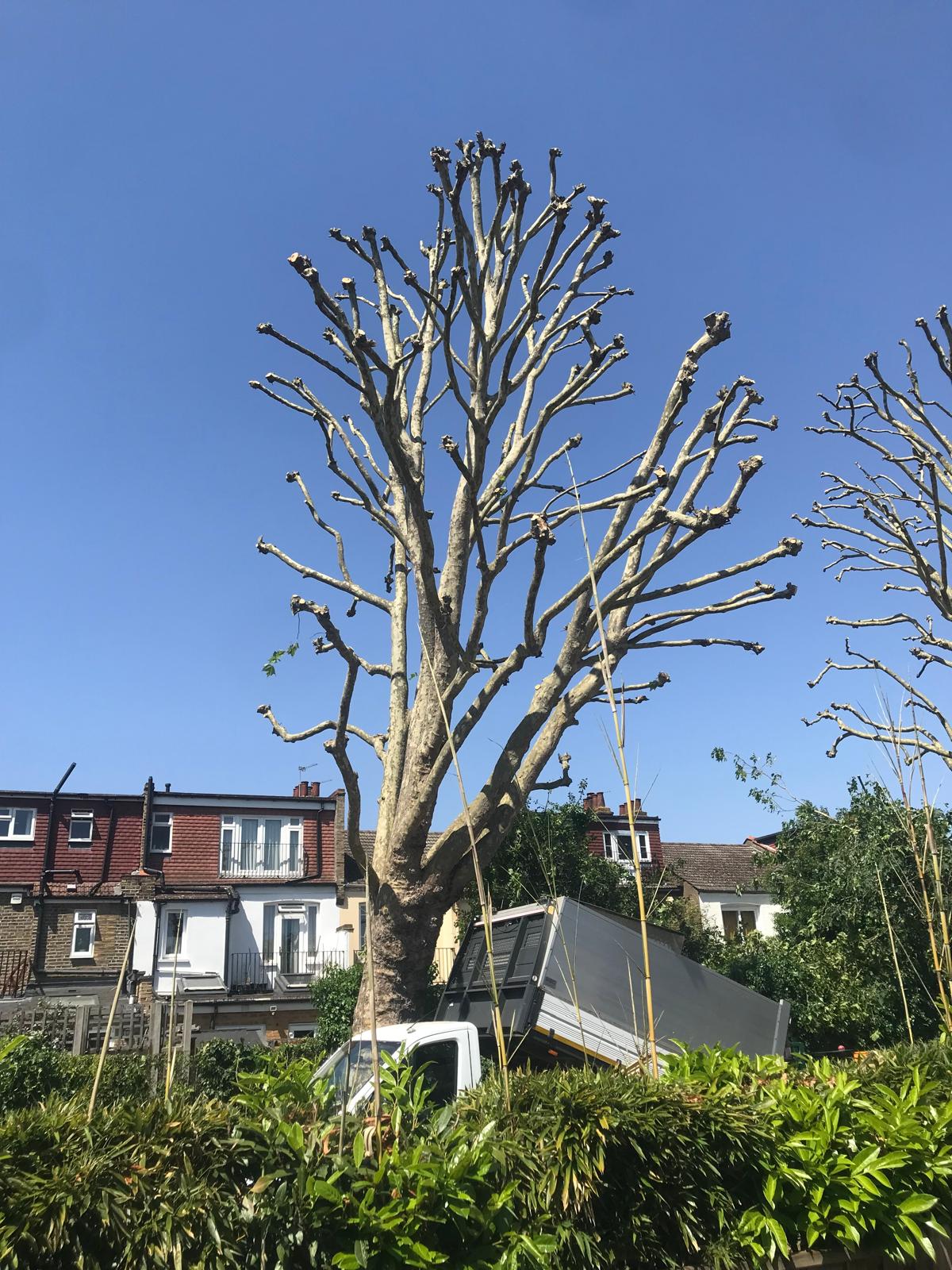
Pollardingin Watford & Hertfordshire— controlled reduction for urban trees.
A traditional cyclical pruning system used to keep large-growing species (limes, planes, willows, poplars) at a permanent manageable height. Only ever start pollarding a tree that suits it — we'll tell you if yours doesn't.
9.94/10 across 502 Checkatrade reviews · Free site visit · Fixed-price quote within 24 hours
Watford · Bushey · Radlett · Harrow · St Albans
What pollarding actually involves
Pollarding is a management system in which the crown of a young tree is initially cut back to a framework of main branches, then re-cut on a regular cycle (typically 2–5 years) to the same points — the 'pollard head'.
Owners of large-growing urban species (lime, plane, willow, poplar, mulberry, some oaks) where the tree needs to be kept at a permanent restricted height because of buildings, wires or highways.
Best started on young trees. Cycled every 2–5 years thereafter depending on species and vigour. Cut in the dormant season (late autumn to late winter).
Pollarding is a commitment, not a one-off. Once started, a tree has to be re-cut on cycle — miss it, and the weight on the pollard heads becomes structurally unsafe. Starting pollarding on the wrong species or a mature tree can kill it. This is a specialist decision.
What happens if you put it off
Pollarding done as a rescue on a mature, unsuitable tree isn't pollarding — it's topping. And topping is usually the beginning of the end for the tree.
Weight failure on old pollards
A pollarded tree left un-cut for 10+ years grows heavy, poorly-attached limbs from the head — the classic 'stag horn' shape that snaps in wind.
Wrong tree, wrong outcome
Species that don't tolerate pollarding (many oaks, beech, most conifers) can be killed outright by heavy heading cuts.
Legal issues
Pollarding a TPO tree without consent is a criminal offence, regardless of intent.
Common mistakes we're called in to fix
- Starting pollarding on a mature tree that was never pollarded before — often fatal.
- Missing pollarding cycles for years, then trying to catch up — the tree can't take it in one go.
- Using pollarding as a marketing name for topping a large tree — it isn't the same thing.
- Pollarding species that don't respond well to heavy heading (avoid on beech, most oaks, most conifers).
A clear, quoted, tidy job — every time
No day rates. No guesswork on the day. You know what we're doing, when, and what it costs before a single cut is made.
- 1
Species & suitability check
First we tell you honestly whether the tree should be pollarded at all, or better crown-reduced.
- 2
Fixed-price quote
Per-tree price — including TPO paperwork if needed.
- 3
Consents
All council notices submitted and consent secured before work.
- 4
Cyclical cut to pollard head
Back to the same points as previous cuts, cleanly, with correct wound placement.
- 5
Cycle scheduling
We agree the next cycle (2–5 years) so it's on the calendar — not forgotten.
What you actually get when we do the job
Permanent height control
Trees stay at manageable size under wires, over buildings and in tight urban spots.
Extends useful life
Traditional pollarding can add centuries to trees like limes and willows.
Manages wind risk
Small, regularly-cut crown = far less sail area in storms.
Predictable schedule
You know when the next cut is due — no nasty surprises.
TPO handled
All council paperwork done on your behalf.
Honest advice
If it shouldn't be pollarded, we'll tell you, and quote for a proper reduction instead.
Pollarding — the full picture
Which species pollard well
Traditional pollarding species include lime (Tilia), London plane (Platanus x hispanica), willow (Salix), poplar (Populus), mulberry (Morus), and some oaks (with care). These species produce vigorous regrowth from cut branch ends and heal well.
Which species to avoid
Beech (Fagus) — very poor response to heavy heading cuts. Most conifers (except yew) — do not regenerate from bare wood. Mature oaks that have never been pollarded — usually a reduction is safer. If you were told your tree 'needs pollarding' as a quick fix, get a second opinion.
The cycle
Once initiated, pollards are re-cut every 2–5 years. Faster-growing species (willow, poplar) go on 2–3 year cycles; slower species (lime, plane) 4–5 years. Missing cycles for a decade or more is a serious safety issue and expensive to correct.
Restoring or ending an old pollard
Where an old pollard has been left, we can sometimes restore it over 2–3 cycles, cutting a bit less than a full pollard cut initially and phasing back to the original heads. Where a tree has never been pollarded and is being retro-fitted late in life, we're usually blunt: don't. A proper crown reduction is nearly always the correct answer.
Pollarding: your questions, answered straight
What's the difference between pollarding and topping?
Pollarding is a lifelong management system started on a young suitable tree and repeated on a cycle to the same cut points. Topping is a one-off severe reduction of a mature tree — it damages the tree and is discouraged in modern arboriculture.
How often does a pollard need re-cutting?
Every 2–5 years depending on species and vigour. Willows and poplars — faster cycle. Limes and planes — slower.
Can any tree be pollarded?
No. Only certain species tolerate it, and it's best started on young trees. We'll tell you honestly if your tree isn't a good candidate.
When is the best time to pollard?
Dormant season — late autumn through late winter. Some species (walnut, cherry) are better cut in mid-summer.
How much does pollarding cost?
Fixed price per tree after a free site visit. Written quote in 24 hours.
Do you handle TPO consent?
Yes — pollarding a protected tree needs written consent, which we apply for on your behalf.
What happens if a pollard is missed for years?
The pollard heads carry heavy, poorly-attached regrowth that becomes a safety issue. We can often restore over 2–3 phased cuts, but it's specialist work.
Is pollarding bad for the tree?
Not when done correctly on a suitable species. Traditional pollards can outlive un-pollarded specimens by centuries. Done wrongly or on the wrong tree, it's harmful — which is why the initial assessment matters.
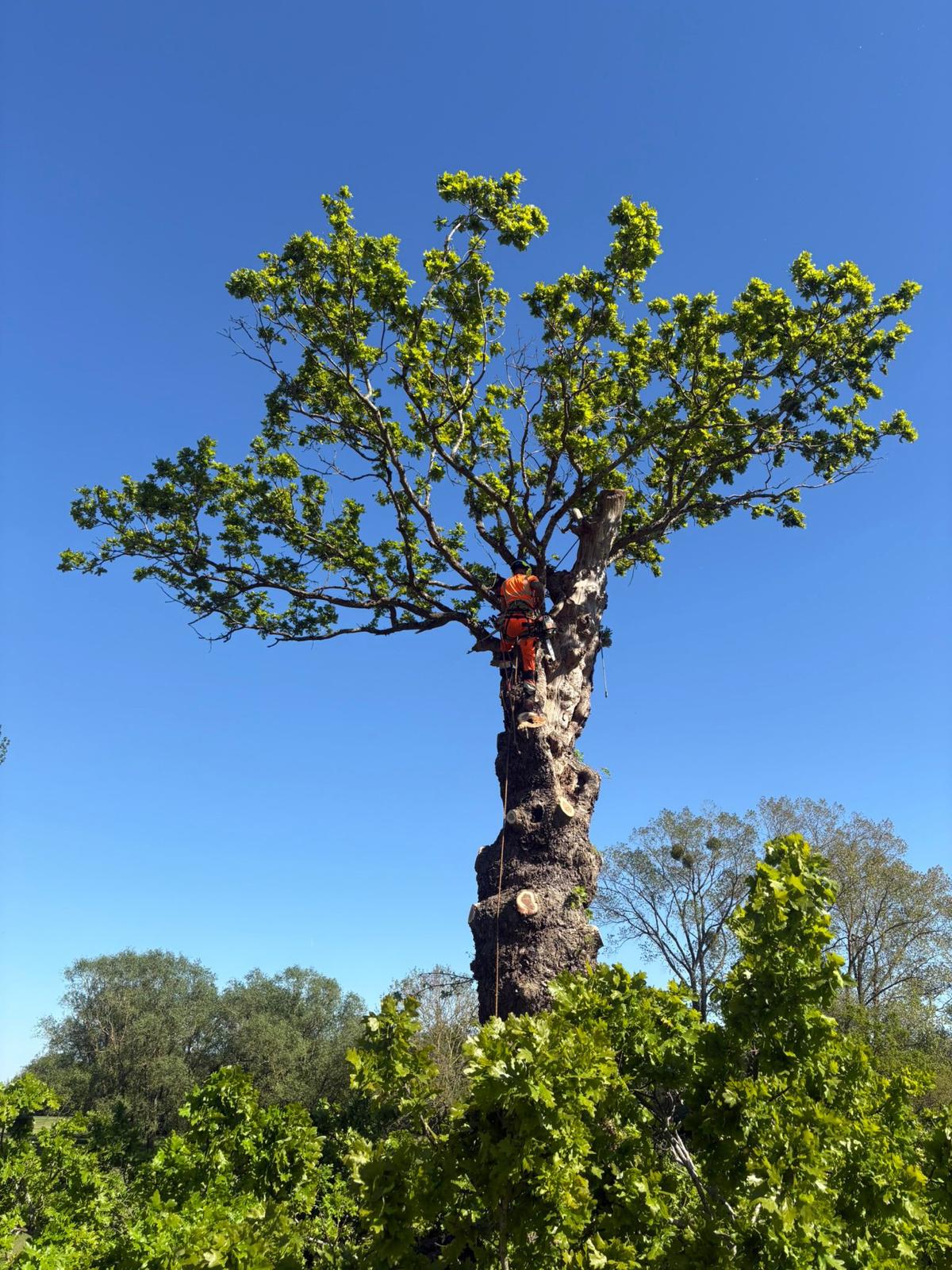
Ready to sort your pollarding? Get a fixed price in 24 hours.
Free site visit. Written quote — not a day rate. Council TPO paperwork handled on your behalf. Full clean-up and all waste chipped or taken away under our Environment Agency waste carrier licence.
- Owner-led team — Sam or the team quote every job in person
- £10m public liability + £5m employers' liability
- NPTC CS39 climbers, City & Guilds qualified
- 24/7 phone answered for emergencies
Request your free quote
Tell us what you need — we'll come and take a proper look.